 We’re so alone
And life is so brief
– “Tears of Rage” (lyrics Bob Dylan / music by Richard Manuel)
I had thought Richard Manuel was old when he killed himself, but, at 42, he was a year younger than I am now … Self-servingly, I have since come to think of old as a mindset and not a number, but when Manuel died in 1986, I was just a dumb high school senior and while I had heard rumors, I had little understanding of Time’s cruelty, if anything, believing its great transgression was that it moved too slow.
Born and raised in the small town of Stratford, Ontario, Richard Manuel joined what would become The Band at eighteen. He was funny, but he was shy; so he he drank his shyness away. He would go on to spend most of his life wasted. When he moved out of his Malibu home in 1976, legend has it that 2000 Grand Marnier bottles were left behind (making him not only a drunk, but also a hoarder). He cavorted with the likes of Keith Moon and Eric Clapton. Under the tutelage of such rock luminaries, he aped the excesses of the 1970s. Beyond downing several bottles of cognac a day, his favorite trick from the rockstar playbook was impishly crashing cars (preferably Ferraris) and, once, a boat. Sadly, he was so drunk during The Band’s “last” performance in 1976 that he’s barely seen in The Last Waltz.

- Manuel & Robbie Robertson: no caption necessary
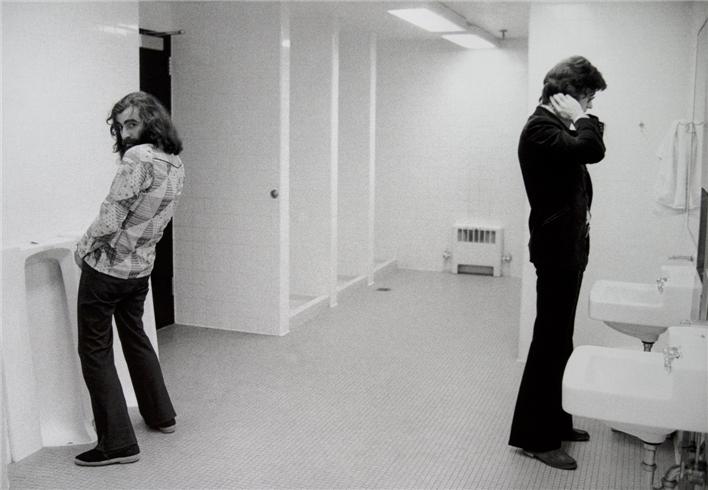
Somehow, in 1984, Richard Manuel was still alive. In a clear attempt at a rebirth, he moved back to Woodstock, got sober – cold turkey – and remarried (his first wife had left him and become a Jehovah’s Witness). He told his new bride that if he began drinking again, he would kill himself.
What was left of The Band (without Robbie Robertson) had reunited in 1983, but it became increasingly clear that they were merely living off the past, ghosts of their former selves. For Manuel it was a bitter pill, one best washed down with a swig of Grand Marnier and a line of blow. By 1985, not only was Manuel hitting the bottle again, but he could no longer hit the high notes that had made him famous.
On March 3, 1986, The Band had just played the Cheek to Cheek Lounge in Winter Park, Florida – clearly a shitbox and a long fall down from The Band’s peak. No wonder he was depressed. To make matters grimmer, The Band was staying at a Quality Inn next door. After the gig he forecast his intentions by thanking bandmate Garth Hudson for “25 years of incredible music.” He spent the remainder of his waking hours with Levon Helm, eventually making the way back to his own room around 2:30. Reportedly, he finished a bottle of his beloved Grand Marnier and did a few lines before climbing into bed with his wife Arli. They fell asleep in each others arms.
When Arli returned from breakfast the next day around noon, she found her husband hanging from the shower rod, a belt around his neck. He was dead. Apparently, Manuel hadn’t slept long the night before – the blow may have had something to do with that – because, according to the police, he died sometime between 2:30 and 3:30 a.m..
To have reached such heights and then be back at the bottom again must have been disappointing. But audiences are fickle and to value one’s artistic self-worth on the ever-shifting popular tastes is an inherently self-sabotaging choice. I don’t know Richard Manuel and I certainly don’t know why he did what he did, but while I imagine The Band morbidly joked that Winter Park, Florida was a long way from Bob Graham’s Winterland Ballroom (venue of The Last Waltz), I’d wager that being booked at the Cheek to Cheek wasn’t exactly the last straw. After all, playing dives is how The Band got started.

- Manuel laid to rest in hometown Stratford, Ontario
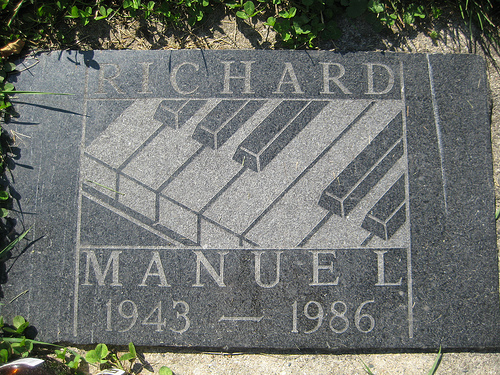
So many rock n roll suicides are stories of promises unfulfilled. We mourn not just what was, but what could have been. Sadly and tragically, at 42, Richard Manuel was old. His voice was shot and his body was ravaged. There wasn’t much gas left in that tank. And he only had himself to blame. He both literally and metaphorically put the pedal to the metal all his life. As Band producer John Simon once said: “He drove 150 mph in the driveway, faster on the highway.” At 42, the speeding tickets had stacked up. The voice that had made him so great was cracked and out of tune. He’d gone all in on the rock n roll dream and when he woke up, his sweet voice had turned sour, lost in the bottom of a bottle of fucking Grand Marnier. He’d already killed the one thing that made him special, the only thing left to do was finish off the job.
from better days (1970)
The Band – Tears of Rage : the first track off Music from Big Pink, Manuel wrote it with Bob Dylan. Buy it here.
 I woke up, pummeled by the glorious, psychedelic assault of The Black Angels. Thank you KEXP. I am haunted, yet free to start the day. If there is a problem with this song, it is only that it is too short … Yet, it should be noted that the Angels, in their mind-expanding omniscience, make no mistakes, they merely bend the world to its will. Not yet under the influence of caffeine, I am now gratefully infused with the eternal life of their crunching guitars. The way is clear: I have no choice, but the future is mine to shape. So, I will play my part in the Angels’ grandly designed plan and order up my tickets to see them Tuesday night at Seattle’s Showbox. The only question is why didn’t I get tickets sooner? The only answer is that I clearly deserve to be sonically flogged – preferably in front of the speakers on stage right.
“Haunting at 1300 McKinley” is off their new album Phosphene Dream. Buy it from the band.
Song of the Day: J Mascis – Circle of Friends
J Mascis makes sweet love to Edie Brickell’s “Circle of Friends” – which is exactly the kind of thing the New Bohemians were probably into when they were the house band for the ecstasy scene in Dallas back in the 80s.
There’s a better version on Pitchfork, but those hipsters are very sneaky and I have been foiled (once again!) in my attempt to embed their content.
Rock n Roll Suicide: Beverly Kenney (1932-1960)
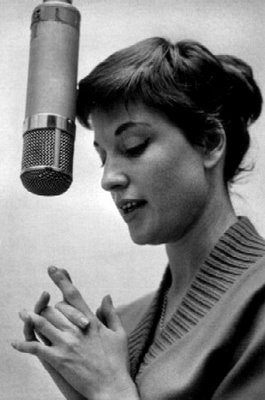 Beverly Kenney was repulsed by rock n roll. In fact, by 1958 the jazz singer despised the new music craze so much that she wrote the protest anthem “I Hate Rock n Roll.” By all accounts Beverly Kenney was an up-and-coming bird on the scene. She was discovered by the Dorsey Brothers and released her first solo album in 1956 at age 24. Downbeat magazine’s Barry Ulanov noted: “It looks as if finally, a new voice of unmistakable jazz quality has appeared to take its place beside those of Sarah Vaughan, Billie Holiday and Ella Fitzgerald … Beverly is beginning to arrive and she is displaying the kind of ability and potential that should enable her to stay a long time.”
On May 18, 1958 she performed on The Steve Allen Show and sang “I Hate Rock n Roll,” seemingly oblivious to what a rebellious, rock n roll move her denunciation of the changing paradigm truly was. As she decried rebels without a cause, she merely proved that she was one herself. “What is the answer to a teenage prayer?” she sang, “Frankly speaking, I don’t care. I don’t care I don’t care …”
On April 13, 1960 – less than two years later after she declared war – rock n roll won the battle when Beverly Kenney overdosed on alcohol and Seconal. She was dead at 28 and is largely forgotten in the United States, while remaining a cult figure in Japan. Being prone to the use of broad cultural stereotypes, I initially assumed her prominence in Japan is due to their longstanding reverential stance towards the glory of suicide – that she is exalted for choosing to die rather than be bloodied by the incoming tide of rock n roll. But journalist Bill Reed, who has written more extensively about Kenney than anyone (check out some of his work here), notes that her death in Japan, when mentioned at all, is generally misappropriated as resulting from a hotel fire.
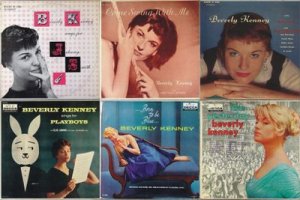
- The Many Looks of Beverly Kenney
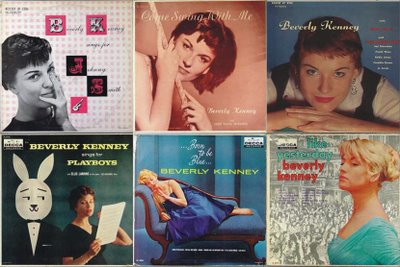
After reading a 1992 article on Kenney in GQ magazine, Reed took it upon himself to investigate the circumstances around Beverly’s death. Most everyone who knew her – and none seemed to know her well – said she was distant (albeit kind) and melancholy. Many were not surprised that she had taken her own life. The one exception was Millie Perkins, a young model, who was probably Beverly’s best friend. She indeed was shocked. In 1959, when tapped to star as Anne Frank in the George Stevens film version of her diary, Millie left New York for California and she never saw Beverly again.
Unknown to Millie, Beverly had tried to kill herself before. (Reed suspects she was bi-polar). While attending a play with her boyfriend, she insisted they leave halfway through the performance and then, when back at her apartment, she downed a bottle of Seconal. She survived the night, but the demons remained. She would admit herself to Bellevue six months later. Whatever treatment she got there was to no avail, she would “successfully” end her life soon thereafter.
Bill Reed was quoted in The Bluegrass Special on Beverly’s television appearance with Steve Allen. Since there is no available video, he will have to stand as our witness: ““[Allen] asks her, ‘Do you really hate rock and roll that much?’ And she kind of took the Fifth. She said, ‘No, no, no, not really.’ But in point of fact I think she probably was being sincere. She was probably the pluperfect example of the very first major singer who came along just five seconds too late. I write a lot about what I call the tsunami of rock and roll that just came and blew everything away … it really drove everything out … So when Beverly died, she was totally broke.”
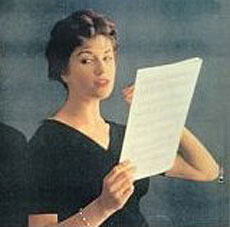 In 1960, rock n roll was on the rise and at 28 this young star on the jazz scene felt like she was washed up. Her voice is easy and free, her phrasing – by all accounts – impeccable. She simply wasn’t made for her time. The world was revolting and she couldn’t stand to watch the spectacle.
Nonetheless, whether she liked it or not, she was a rocker, which is fitting because (as a reflection of her alleged bi-polarity) Beverly Kenney was a mass of contradictions. She was brooding, introspective and sad, but she willingly bared it all for Playboy magazine (although the session went poorly and the negatives were destroyed). She apparently feared change, yet her appearance differs dramatically from photo to photo. And, finally, in response to the insurgent new music sweeping the land, she committed the ultimate act of rebellion and took her own life.
She said she hated rock, but perhaps she protested too much, for of course, those things that we hate are so often the things that remind us the most about ourselves.
Beverly Kenney – I Hate Rock n Roll Mp3
“Give Me the Simple Life” from her 1956 LP Come Swing With Me:
 We are so strong and we are so free
We just killed the Boogeyman, didn’t you see?
But, before he was cold, the bleating began.
“We’ll go from the fire back to the frying pan!
We better be ready, maybe we should hide?
Now that he’s gone, surely more of us will die!”


 lonesomebeehive