Best Songs Ever: Serenading Joe DiMaggio
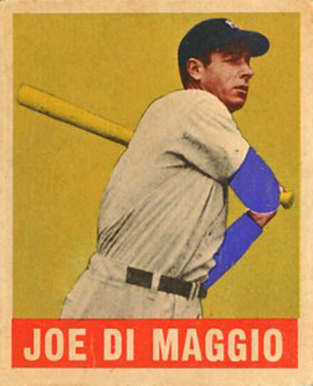 No ballplayer has been immortalized more often in song that Joe DiMaggio. This, however, is a dubious distinction since among those dropping DiMaggio’s name include Billy Joel, Jennifer Lopez and Bon Jovi. Of course, that is the price of fame, everyone wants to ride your coattails. Meanwhile, one the most quoted lines in all of pop music is ‘Where have you gone Joe DiMaggio? A nation turns it’s lonely eyes to you” courtesy of Paul Simon, who elegantly wrote about the song’s meaning in a New York Times op-ed shortly after DiMaggio’s death in 1999: “DiMaggio represented the values of that America: excellence and fulfillment of duty (he often played in pain), combined with a grace that implied a purity of spirit, an off-the-field dignity and a jealously guarded private life.”
“What’s that you say, Mrs. Robinson? Joltin’ Joe has left and gone away?” Well, with a little help from Paul Simon, Joe DiMaggio won’t soon be forgotten, even if the grace and dignity he embodied is now rarely exhibited by modern athletes.
If only it were that simple. More likely, it seems, the grace and dignity attributed to DiMaggio was just an illusion propelled by our pathological need to create heroes (and then destroy them). After all, Joe DiMaggio is notorious for insisting on being introduced as “The Greatest Living Ballplayer,” which certainly rankled many of his colleagues. I’d think Willie Mays would be especially offended. By every metric he was superior to DiMaggio, who incidentally was the player Mays had most tried to emulate. Nonetheless, insisting on being called “The Greatest” tarnishes the very notion. The kind of bravado may work with boxing, but with baseball – a team sport – it doesn’t go down so smooth.
While his ego may have gotten a bit out of hand, still, I love Joe DiMaggio. Thanks to the three or four minutes he gave me and two of my friends on a summer evening in 1981, I will forever be a fan. That night, he was throwing out the first pitch for the Columbus Clippers, the Yankees’ AAA team. Coincidentally, a colleague of my dad’s was hosting our family in a skybox – the only time I’ve watched a game behind glass – and the press box was right next door. Like giggling hyenas, we waited for Mr. DiMaggio to come up after he had fulfilled his ceremonial duties. As he exited from the elevator, there were three of us there to ambush him and to our immense surprise, he graciously invited us all into the booth. It felt like ten minutes, but the interaction must have been less than half that. It doesn’t really matter, for those few moments, Mr. DiMaggio was completely engaged. He seemed honestly happy to meet us. He asked our names and gave us a brief tour of the box. I collected autographs from ballplayers back then and of all the greats whose path I crossed, Joe DiMaggio was the one who made the most effort to connect. From the height of his monumental fame, he actually made me feel like a person, a feat seldom accomplished by an adult, let alone a living legend. Each of us walked out with a huge smile on our face and an autographed ball that proved it wasn’t all just a dream. I was giddy for weeks.
While I think Joe DiMaggio is great, the songs about him unfortunately tend to come up short. Certainly, “Mrs Robinson” deserves to be the classic that it is, but it’s not really about DiMaggio or, for that matter, baseball. So it doesn’t qualify. “Centerfield” by John Fogerty, features DiMaggio, but I could quite happily live without ever hearing it again. It’s off the list. “Bloody Mary” from South Pacific says a girls’ skin is “as tender as Joe DiMaggio’s glove” – which is disturbing on so many levels. Pass.
The song that was most associated with DiMaggio during his career was “Joltin’ Joe Dimaggio,” originally recorded by Les Brown’s Orchestra in 1941. Betty Bonney is the singer. Sadly, this song is largely ruined by the unctuous, snearing male background vocals. Their hearts clearly weren’t in it, leading me to believe that the boys in the band rooted for the Dodgers. It’s the kind of novelty tune that was routinely churned out in the 1940s and 50s and like ditties about Willie Mays and Jackie Robinson from the time, you can hear them on just about any baseball compilation. The soundtrack to Ken Burns’ excruciatingly boring documentary “Baseball” comes to mind. Don’t buy it, though, it’ll only encourage him. Better yet, just listen to Bob Dylan’s Theme Time Radio Hour. He did a glorious show on baseball. Listen to (and download) it all here. It’s great.
Les Brown’s “Joltin’ Joe DiMaggio”: Les Brown’s Orchestra – Joltin’ Joe DiMaggio MP3
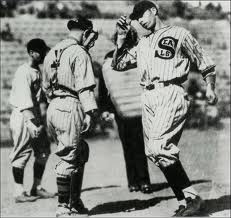
Joe DiMaggio of the SF Seals
For a much better, less grating, version, check out the SF Seals take from 1993. Joe actually played for the San Francisco Seals, so they are uniquely qualified to sing about him. Their EP, Baseball Trilogy, now has two mentions on the Best Baseball Songs Ever list. “He’s just a man and not a freak,” they sing. Ironically, Tim Lincecum, the best player in San Francisco, is now heralded as The Freak. Oh, how the times change, no one wanted to be a freak back in the old days. Now it’s a badge of honor.
SF Seals – Joltin’ Joe DiMaggio MP3
Billy Bragg and Wilco recorded two albums worth of unpublished Woody Guthrie songs in the early 200os. There are some real gems in the collection and “Joe DiMaggio’s Done It Again” may be one of them. It’s the best of the DiMaggio tunes, but I’m torn. And I suspect Woody Guthrie was, too. There’s certainly a reason why he never actually wrote music to accompany the lyrics in his lifetime. In many ways, it would be as if Bob Dylan penned a love letter to Richard Nixon. As a notorious subversive, it’s the kind of secret you might want to hide in your attic, which is exactly what Guthrie did. After all, Woody Guthrie was a man of the people, an advocate for the discarded and downtrodden. The Yankees, meanwhile, were – as they are now – an Evil Empire. Joe DiMaggio was the most popular guy in school; he didn’t exactly need a folksinger to sing his praises. Guthrie tries to mitigate this issue by casting DiMaggio as an underdog: “Some folks thought old Joe was done!” There’s also a reference to a hurt heel. Guthrie wrote the lyrics in 1949 when DiMaggio only played 79 games. Two years later Joltin’ Joe’s baseball career was over. Perhaps, Guthrie should have written a song about Jackie Robinson instead.
Billy Bragg and Wilco – Joe DiMaggio’s Done It Again MP3
So, while none of the songs heralding Joe DiMaggio are as great as he was, there are enough of them to collectively lock up a spot on the list. I probably wouldn’t feel that way had I not met the man and seen him live up to the platitudes attributed to him by Paul Simon. DiMaggio was not just the hero I wanted him to be, he was one of the defining heroes of the 20th century. It can’t be easy to live that life, to be a god among men. Yet, he was gracious and kind. He treated us as if it was his privilege to meet us. That signed ball remains one of my few prized possessions, but much more than his autograph, he gave me something much more valuable: a few moments of his time.
Best Baseball Songs Ever: Greg Brown – Laughing River
Greg Brown – Laughing River (1992)
We’re always told that if we work hard enough, we’ll achieve your goals. But sometimes that’s not the way it goes down. Hard work and dedication doesn’t always pay off. In baseball, as in life, not only do you have to be good to succeed, but you also have to get the opportunity to prove yourself. Some guys don’t live up to the chance when they get it, while some guys don’t ever get the chance at all.
“Laughing River” is a devastatingly beautiful song about a career minor leaguer who, after twenty years, is finally ready to give up on the dream of making it to the big leagues. He’s going to trade his bat for a fly fishing pole. “I’m going away because I got a busted heart,” he sings. But while his baseball dreams may not have come true, our narrator isn’t defeated. Instead of the big leagues, now he has his sites set on a better life along Michigan’s Laughing River.
This song guts me each time I hear it, not because of the sadness of giving up, but because in the face of failure, our narrator has the optimism to see a better future down the line. His resilience is an inspiration. It’s easy to become bitter as we face our failures, to look for scapegoats, to search for answers that might explain why we fell short, while others – surely less talented – succeeded. This song’s narrator, though, doesn’t play that game. He doesn’t second-guess himself; he’s just ready to move on. He has a new dream and the fact that it’s along the Laughing River suggests that our narrator understands that while the world may laugh at our dreams, as long as we look optimistically to the future, we get the last laugh, for it is our dreams that keep us alive.
Buy the album here.
Greg Brown – Laughing River MP3
(song begins :47 seconds in)
Georges Bizet – Toreador from Carmen (1875)

Georges Bizet: The Original Bad News Bear
This quitting thing, it’s a hard habit to break once you start. – Coach Morris Buttermaker
How did an opera that was first performed one year before the establishment of the National League produce one of the best baseball songs ever? And how is it that an aria about the glories of bullfighting is, in fact, best suited to baseball? Thank The Bad News Bears (1976) and its soundtrack’s composer Jerry Fielding, who liberally utilized not only “Toreador,” but other themes from Carmen, elevating what could have been a pedestrian tale of overcoming adversity into an epic exploration of triumph and redemption set against a prophetically searing portrait of unbridled competition’s dark side.
My father took me to see The Bad News Bears when it came out. I was eight years old and as I recall, he attempted to cover my ears when the cursing began, but it quickly became evident that was a losing strategy and soon thereafter he gave up. At the time, I thought it was the greatest movie I’d ever seen and to this day, it remains in my top ten.
Not only does The Bad News Bears capture an authentic slice of Americana, but it also transforms one of the seminal musical compositions of the 19th century. At first glance it may seem ironic to mix high and low culture, but when you’re a kid, your trials and tribulations are everything. Jerry Fielding and director Michael Ritchie understood that there is nothing ironic about feeling the huge sweep of emotions life offers for the first time. The soundtrack accentuates the monumental scope of a little league season, leaving an emotional echo that lasts long after the credits fade. It is a tremendous achievement.
The montage beginning at 5:16 chronicles the rocky rise of the Bears, propelled by an ingenious remix from Carmen and ends about a minute later when Ahmed takes a fly ball in the nuts.
Losing never felt so sweet. If only we could learn this film’s great lesson: winning at any cost is not winning at all.
Best Baseball Songs Ever: Nelly – Batter Up
Nelly – Batter Up (2000)
 I often wonder what’s going through my 83 year-old father’s head when he’s exposed to our culture’s rougher edges. He’s a pretty straight guy. To this day, he still suits up and goes to the office every morning. It is because of him that I fell in love with baseball and while the Great American Past-time is generally a safe haven from the vulgarities of modern life, it is certainly not immune – whether from ear-blasting transitions of Fox game coverage to the terrible music that frequently intrudes at the ballpark – and I can’t help be offended for him, even if he seemingly doesn’t care. In my eyes, the man simply deserves to live in an aesthetically more pleasing world.
While frequently there is no escape, sometimes there is a choice, which is why there should be a rating system, where parents are restricted from material unless their children say it’s okay. For example, I told my mom not to take my dad to Black Swan. I knew it was not suitable viewing. But like a petulant teenager, she ignored me. And yes, they both regretted it. No doubt, some of the images haunt my dad today. Like when Mila Kunis was going down on Natalie Portman? What could my dad have been thinking? For me, it was actually the best part of a tedious, cliche-ridden film. For him, he must think the apocalypse has already begun.
It’s times like this when I am embarrassed for our culture. I can’t help but I wonder if my dad feels like the future has let him down. Worse, I somehow feel responsible. Unfortunately, he won’t talk to me about these things. He either changes the topic or hands the phone off to my mom. In the end, I suspect the thoughts in his head aren’t nearly as bad as I think they are. He probably just filters it all out.
While ordinarily “Batter Up” is just the kind of the spectacle I’d want to shield my father from, perversely, I would, however, like to see him watch Nelly break it down St. Louis-style since like Nelly, my father is a lifelong Cardinals fan. Surely he would find the rump-shaking in the video scandalous. Most certainly, he wouldn’t understand the use of The Jeffersons Theme Song, or even know who The Jeffersons are. Would he have any idea what “Smoke some herb and clear your mind” means? Unlikely.
My dad, however, would probably agree with Nelly’s sentiment, “What the fuck wrong with the world today? With these girls today?” They’d probably also both concur that if the Cardinals are going to make a run for it this year, they better get another starting pitcher to replace the injured Adam Wainwright.
Since, it’s unembeddable, check out the uncensored (although stretched) video here. Inexplicably, on Nelly’s channel, it’s censored here.
 Wow, that’s a pretty good Valentine’s Day show. I can’t help but wonder if the fact that I can’t remember a single thing about this concert has anything to do with my failure to still be with the woman I lived with (and presumably my date that night) when Valentine’s Day 1993 came around.
I do, however, remember my recent attempt to see Dinosaur Jr.’s reunion show in Victoria, BC in November 2009. So, while this stub is humbling, it is nonetheless a window into the pitfalls of trying to relive the forgotten past.
And I can’t say I wasn’t warned.
“Noooooooo …. Dude! Don’t do it. You go into the vortex and you never get out. That place is HELL!!!!” That’s what a young skate-rat on the streets of Victoria told me and my friend Jonathan when we mentioned that we were going to see Dinosaur Jr. play at the club Sugar later that night.
Naturally, I suspected he was on drugs or perhaps a schizophrenic (simply an observation, not a judgment). It turns out that he is a modern day Nostradamus. As prophesied, the only thing sweet about Sugar is its alluring name. I would come to learn the hard way that this venue is like candy in a pedophile’s hand and whatever you do, don’t get in that van. You’re in for a rough ride.
The stage was buried in a hole in what can only be described as an extremely narrow and confining space. Not only had the street urchins of Victoria pointed out that the sound system is awful, but it was pretty clear that due to the low, cascading ceiling that the acoustics were going to suck as well. In an awful venue, your only hope is to get close to the stage, so Jonathan and I figured out best bet was to make our way to the front. After all, Dinosaur Jr. brought several stacks of Marshall amps. All our problems were theoretically solved.
With only minutes to go before Dinosaur was set to take the stage, we were ready to bask in the waves of crunching guitar. Unfortunately, to add to their claustrophobia-inducing layout, the venue had absolutely no circulation and it was so unbearably hot that each step closer to the stage was one step closer to the heart of hell. The band hadn’t even started and I was growing faint.
Having never fainted before, I tried to fight it, but alas, it was a battle I was destined to lose. I blacked out before the show even started. Now I know what it was like to be a 14 year old girl at a Beatles concert. I was back on my feet in no time and Jonathan heroically got me to the hallway that leads to the street and in a few minutes, I was seemingly fine. The music beckoned, but unfortunately, each time we tried to make our way back into the crowd (i.e. the Vortex), I was overwhelmed by the heat and had to retreat. We eventually gave up and went back to our hotel before the second song even began.
I suppose I should be grateful to Sugar for the good times. Not only have I gotten a glimpse of hell, but I’ve also seen a preview of what it’s like to die. In the scheme of life, this isn’t exactly unwelcome knowledge to have … but I really would have just liked to have seen a bit more of Dinosaur Jr. While I’m pretty sure I had an exponentially better time in 1992, at least this time I remembered it.
Live on the BBC, 1993:


 lonesomebeehive